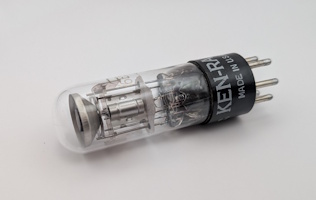
The 6E5 is one of the earliest examples of a magic eye tube, which were invented in 1932 by American electrical engineer Alan DuMont. They were designed as a cost-effective alternative to expensive needle indicators and were intended mostly for use in consumer devices such as radios that required user tuning without high precision. The first commercially available 6E5 tubes were made by RCA starting in 1935 and featured a coke-bottle-shaped glass envelope common in early vacuum tubes.
Read more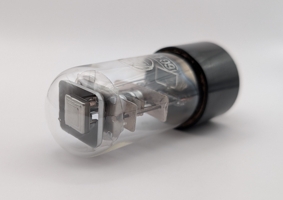
The 6G-E12A is peculiar magic eye tube manufactured by the Japanese company TOYO. Unlike most top-viewing magic eyes tubes, such as the common 6E5, which feature circular screens, the 6G-E12A’s screen is rectangular. It is the successor to the 6G-E12 tube, which features a similar rectangular screen design but has a different display characteristic.
The 6G-E12A is a so-called double indicator tube, meaning it has two independently controlled shadow angles. This allows it to visualize two signals simultanously which made it particularly suitable for FM stereo indication. For simplicity, I connected both channels together in the video shown below.
Read more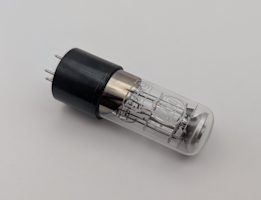
The 6ME5 (also known as 6M-E5) is a miniature magic eye tube manufactured by TOYO in Japan. It closely resembles the common 6E5 tube, but in a smaller form factor. It features the same basic display characteristic of a single shadow that opens or closes according to the supplied input voltage. The tube requires a relatively low target voltage of only 180V (opposed to the 250V typical for most magic eyes), the closely related 6ME10 even just 100V.
Read more