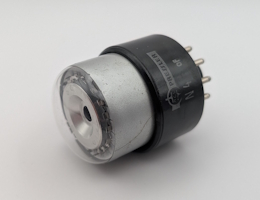
The N4 is a neon-filled decadic counting tube manufactured by the German company DGL Pressler (Deutsche Glimmlampen GmbH), which is mostly known for making discharge tubes and phototubes. The tube operates in a unidirectional, single-pulse mode and each of its ten stable cathodes is accessible externally via a separate pin. According to its datasheet, the N4 is capable of up to 25,000 counts per second, making it exceptionally fast for a neon-filled Dekatron.
Read more?
Dekatrons are gas-filled counting tubes primarily used in early computers, calculators and devices requiring frequency devision during the 1950s and 1960s. When a Dekatron is in operation, a discharge occupies one of typically ten stable positions. Each counting pulse moves the discharge to the next cathode, often generating a voltage spike that can trigger specific actions.
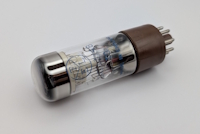
The GC12/4B is a neon-filled counting tube manufactured by ETL in Great Britain. It is capable of bi-directional operation at up to 4,000 counts per second. It features twelve stable cathodes, unlike the usual ten found in most Dekatrons, which allowed it to be used for base-12 counting. Four of these cathodes are accessible via output pins, enabling them to trigger actions such as advancing another Dekatron when active. Divide-by-12 Dekatrons like the GC12/4B were ideal for timekeeping applications since the division of hours, minutes, and seconds in a day aligns with multiples of twelve.
Read more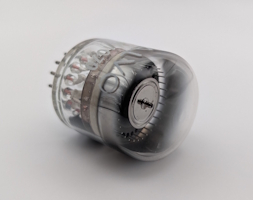
The ZM1070 is a neon-filled, double-pulse decadic counting tube manufactured by Valvo in Germany. It supports bi-directional counting and operates at speeds of up to 5,000 counts per second. Each of its ten stable cathodes is connected to a separate pin, allowing external actions (such as advancing a second stage Dekatron) to be triggered when a specific cathode is active. This design also enables the tube to be reset to any of its ten positions by applying a brief negative pulse to the desired electrode.
Read more