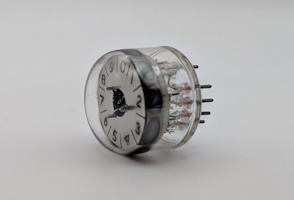
When the Nixie tube was introduced in the 1950s, it faced a significant drawback: its driving circuitry required transistors with relatively high breakdown voltages capable of handling the elevated operating voltages necessary to drive them. At the time, such transistors were not readily available. This limitation created a demand for an alternative display technology that could be operated with low-voltage, low-current logic circuitry. The solution was the Z550M, which was later renamed to ZM1050.
Read more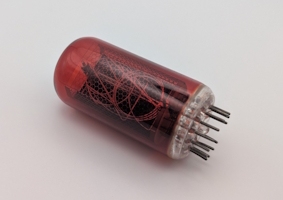
The ZM1040 is a large Nixie tube produced by various European manufacturers, with this particular unit made by Valvo. Tesla, a Czechoslovakian manufacturer, produced a version of the ZM1040 that featured a square anode grid, setting it apart from the one shown here. To enhance contrast and filter out blue light emitted by the included mercury vapor, the tube is covered with a red filter. A variant without this filter was also available under the designation ZM1042.
Read more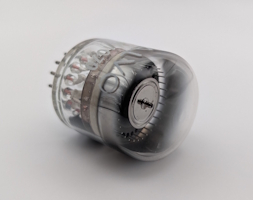
The ZM1070 is a neon-filled, double-pulse decadic counting tube manufactured by Valvo in Germany. It supports bi-directional counting and operates at speeds of up to 5,000 counts per second. Each of its ten stable cathodes is connected to a separate pin, allowing external actions (such as advancing a second stage Dekatron) to be triggered when a specific cathode is active. This design also enables the tube to be reset to any of its ten positions by applying a brief negative pulse to the desired electrode.
Read more